

8x42 vs 10x42 Binoculars for Wetland Birdwatching: A Practical Comparison
How 8x42 and 10x42 binoculars differ in field of view, low-light brightness and hand-held steadiness — and which suits reedbeds, estuaries and open water.
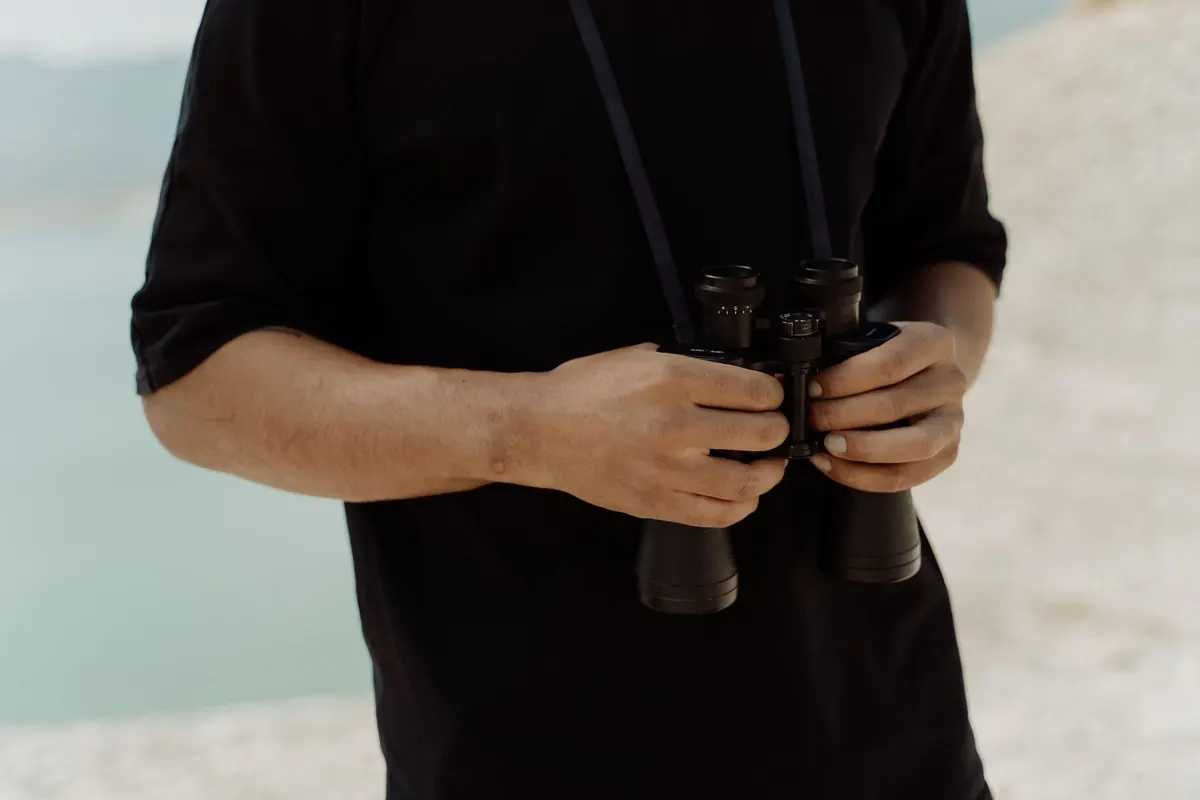
A hide at first light in February: grey sky, reeds shifting, and somewhere out on the lagoon a bittern doing its best impression of a reed stem. The person beside you lifts a pair of 8x42s and finds a water rail in seconds. You are on 10x42s, you have found the same patch of reeds, and you are fighting a small wobble that will not settle. Both binoculars are perfectly good. They are just good at different things.
Most wetland birders end up choosing between these two sizes. What follows is how they behave in real conditions — dull mornings, big flocks, long mudflats — and which tends to suit which kind of day out.
What the numbers actually tell you
An 8x42 magnifies eight times and uses 42 mm objective lenses at the front. A 10x42 magnifies ten times, with the same 42 mm objectives. That single difference in magnification drives everything else.
Divide the objective size by the magnification and you get the exit pupil: the width of the light beam leaving the eyepiece, in millimetres. For an 8x42 that is 5.25 mm; for a 10x42 it is 4.2 mm. A larger exit pupil is more forgiving about where your eye sits behind the eyepiece, and it gives a brighter image when light is short. Both pairs gather the same amount of light through the same 42 mm glass — the 10x simply spreads it across a bigger image, which is why it looks dimmer in poor conditions.
Field of view: the difference you notice first
A typical 8x42 gives a real field of view of roughly eight degrees, which is something like 140 metres across at 1,000 metres. A typical 10x42 gives about six degrees, perhaps 105 to 115 metres. Move from one to the other and the change is obvious. With the 8s, a whole raft of wigeon sits inside the frame. With the 10s, you are looking at four or five birds and nudging the barrels sideways to find the rest.
That matters most when things move. A lapwing flock lifting off the wet grass, dunlin twisting over the mud, sand martins flicking low across a lagoon — all of these are easier to get onto, and stay on, with a wider view. The wetland edge is full of birds that appear at the side of the frame and vanish again: Cetti's warbler in the bramble, a bearded tit dropping into the reeds, a kingfisher already halfway to the next perch.
Do check the specification rather than trusting the rule. Some modern wide-angle 10x42s are impressively wide, and a few 8x42s are narrower than they should be.
Low light and the grey hours
Wetland birding is a low-light business. Winter afternoons fade early, drizzle eats contrast, and the best activity often happens either side of the day. A bittern at dawn, wigeon arriving at dusk, curlew and lapwing settling into a roost as the light goes: this is when the bigger exit pupil of an 8x42 earns its keep. Colours stay truer, shadowed reed edges hold more detail, and you are less likely to be squinting into a dark tunnel behind the eyepiece.
How much this helps depends on your own eyes. Pupils dilate less as we age, so a young observer may take full advantage of a 5.25 mm exit pupil while an older one will not. And optical quality matters as much as the arithmetic: a well-coated 8x42 will comfortably beat a cheap 10x42 in dim light. If you mostly bird in bright coastal sunshine, the brightness argument carries much less weight.
Stability: the honest trade-off
Ten times magnification means your handshake is magnified ten times too. On a calm day, elbows tucked in, most people can hold a 10x42 steady enough to read a bird. Add a stiff breeze coming off an estuary, a cold walk to the hide and a bird that will not sit still, and the extra detail starts to swim in and out of focus. Resolution you cannot hold is resolution you do not have.
There are ways to manage it:
- Rest your elbows on the hide shelf, or brace your forearms against the window frame.
- Slide back from the opening — a hide ledge transmits every knock from the people beside you.
- Use a harness rather than a neck strap; it steadies the load and keeps the binoculars close to your chest.
- Breathe out slowly as you settle on a bird, and hold the barrels near the far end.
- For seawatching or long-range scanning from one spot, mount the 10s on a tripod or monopod.
Some birders hand-hold 10x42s happily for hours. Others never quite settle with them. This is not something you can reason your way through on paper.
Which suits which wetland job
- Reedbed and scrub: 8x42. Wider view, quicker to find a skulking bird, brighter in the shade under willows.
- Open water and distant waders: 10x42. The extra magnification helps you judge bill length on curlew against whimbrel, or pick a ruff out of a dunlin flock.
- Birds in flight and visible migration: 8x42. Hirundines, terns and raptor movements are easier to track across a wide sky.
- Coastal seawatching: 10x42, tripod-mounted if you can.
- Dragonflies, plants and close work: whichever has the better close focus, which is usually the 8x42.
- Dusk roost counts: 8x42, for the light.
Things that matter more than the numbers
Two 10x42s can differ far more from each other than an average 8x42 differs from an average 10x42. Before anything else, check these:
- Waterproofing. Nitrogen-purged and fully sealed is not a luxury in a wetland. Rain, spray and condensation will find any weak point.
- Eye relief. If you wear glasses, look for at least 15 mm of quoted eye relief and twist-up eyecups. Otherwise you will be pressing the glass against your lenses.
- Coatings and glass quality. This is where your money goes, and it shows in dull light.
- Weight and balance. A heavier pair that hangs comfortably beats a light pair that feels awkward in the hand.
- Focus wheel. A smooth, reasonably quick focus helps when you are working through reeds at close range and then out to a distant raft.
- Dioptre adjustment and interpupillary distance. Set both properly once, and the view will feel calmer immediately.
Keep the rainguard on between scans, wipe lenses with a proper cloth rather than a sleeve cuff, and let the binoculars come up to room temperature before you clean them after a cold session. Grit and condensation cause more damage than rain ever will.
Making the choice
If you can only own one pair, work through it in this order:
- Look at where you actually bird. Reedbeds, hedges and mixed reserves point to 8x42. Big estuaries, open lagoons and long-range identification point to 10x42.
- Try both, ideally on the same day at the same reserve. Many wetland centres run optics events, and a borrowed pair at a hide will tell you more in ten minutes than a week of reading.
- Compare the specification sheets of the specific models you are considering, not the categories as a whole.
- Spend what you can reasonably afford on the best glass you can get, then add a harness.
The 8x42 is the safer all-rounder for wetland birding: forgiving, bright, easy to hold on a moving bird. Choose the 10x42 if distance is the thing that most often frustrates you, and accept that you will need to work a little harder to keep the view still. Either way, the birds are the point — a pair you use often will show you more than a pair you bought for the specification.
Photo: cottonbro studio / Pexels